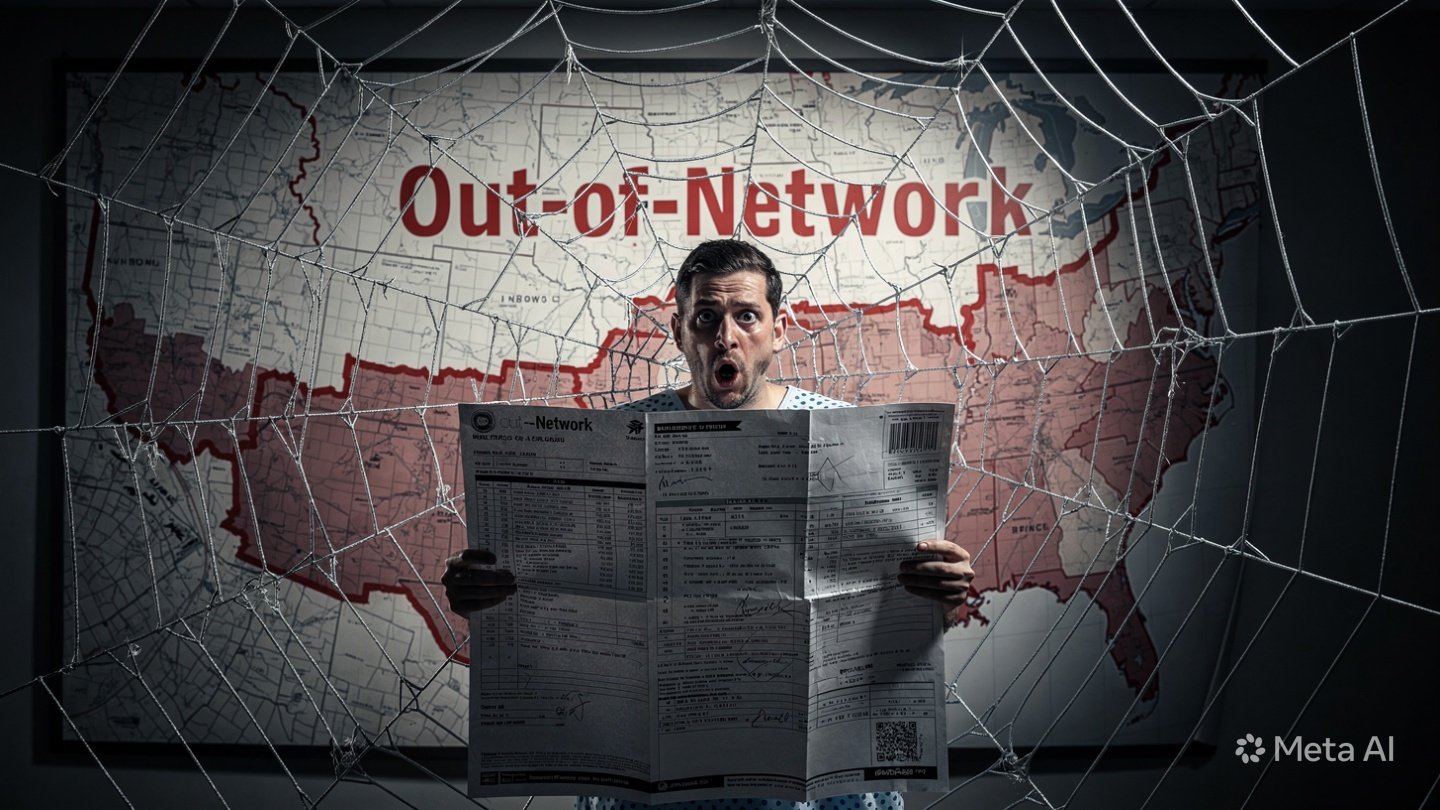
The Out-of-Network Trap That Still Haunts Millions of Americans
You check into an in-network hospital for a scheduled surgery. You verify your insurance, confirm the facility is covered, and breathe a sigh of relief. Then the bills start arriving. The anesthesiologist was out of network. The assistant surgeon was out of network. The radiologist who read your X-ray was out of network. Suddenly, you owe thousands of dollars you never planned to spend.
This is the out-of-network trap, and it still haunts millions of Americans every single year. You did everything right. You chose a participating hospital. You confirmed your coverage. And yet, you are still facing balance bills that can drain your savings and destroy your credit. Understanding how this happens—and what you can do about it—is the difference between financial disaster and financial survival.
Why the Trap Still Exists Despite New Laws
You may have heard about the No Surprises Act, which took effect in 2022. This federal law was designed to protect patients from exactly this scenario. So why are millions of Americans still getting hit with unexpected out-of-network bills? The answer is more complicated than you might think.
The Specific Loopholes That Leave You Exposed
The No Surprises Act is powerful, but it is not all-powerful. It covers surprise bills for emergency services and certain non-emergency services at in-network facilities. However, there are still significant gaps in protection that leave patients vulnerable:
- Ground ambulance services are famously excluded from federal surprise billing protections. An emergency air ambulance might be covered, but a short ground transport to a local hospital can still result in an out-of-network bill of $1,000 or more.
- Non-emergency, scheduled services where you knowingly choose an out-of-network provider do not trigger the law’s protections. If your doctor refers you to a specialist and you sign a form without reading the fine print, you may waive your rights.
- Certain types of facilities like hospital outpatient departments may not always fall under the same strict rules as inpatient admissions.
The Problem with “Notice and Consent” Forms
Hospitals and providers have found a workaround. They ask patients to sign a “notice and consent” form before a procedure. By signing this form, you agree to waive your surprise billing protections and accept out-of-network charges. In the chaos of pre-surgery paperwork, many patients sign these forms without realizing what they are giving up.
If you sign one of these forms voluntarily, you are legally agreeing to pay the out-of-network rate. This is not illegal. It is not even unethical in the strictest sense. But it is a trap that catches millions of Americans who are too stressed or rushed to read the fine print.
The Real-World Financial Devastation
Numbers are abstract until they happen to you. Let us put some real dollar amounts on what an out-of-network trap looks like in practice. These figures are based on typical claims data and patient experiences.
What Balance Billing Actually Costs You
Imagine you need gallbladder surgery. You choose an in-network hospital with a good reputation. The hospital’s negotiated rate for the surgery is $15,000. Your insurance pays $12,000, and you owe a $3,000 copay. That is painful but manageable.
Then the anesthesiologist’s bill arrives. They do not participate in your insurance network. Their “billed charge” is $5,000. Your insurance pays $2,000, which is their usual and customary rate for that service. But the anesthesiologist expects the full $5,000. They **balance bill** you for the remaining $3,000.
That $3,000 is entirely unexpected. You cannot plan for it. You cannot negotiate it beforehand because you did not even know you would need an anesthesiologist until the morning of surgery. This is the essence of the out-of-network trap: bills for services you never chose, from providers you never selected, at prices you never agreed to.
The Domino Effect on Your Finances
One surprise bill rarely stays alone. When you cannot pay the anesthesiologist, that bill goes to collections. When it goes to collections, your credit score drops. When your credit score drops, your interest rates on everything—credit cards, car loans, mortgages—go up. A single $3,000 surprise bill can cost you $10,000 or more in higher interest payments over the next five years.
The stress compounds. You start avoiding medical care because you are afraid of more surprise bills. You delay checkups. You skip screenings. You rationalize that you feel fine. And then, a small, treatable condition becomes a large, expensive, and possibly fatal one. The out-of-network trap does not just hurt your wallet. It hurts your health.
Your Rights and Protections Explained
Despite the gaps, you have more rights than you probably realize. Understanding those rights is the first step to protecting yourself.
The No Surprises Act: What It Actually Covers
The federal No Surprises Act provides specific, powerful protections in three key situations:
- Emergency services: If you go to an emergency room, all services you receive—including care from out-of-network providers—must be billed at in-network rates. You cannot be balance billed for emergency care.
- Non-emergency services at in-network facilities: If you receive scheduled non-emergency services at an in-network hospital or surgical center, ancillary providers like anesthesiologists, radiologists, and pathologists must also be treated as in-network.
- Air ambulance services: Air ambulance transport is covered under the federal protections in most situations.
If you fall into any of these categories and receive a balance bill, that bill is likely illegal. You do not have to pay it. You should appeal it immediately.
When You Can Still Be Billed (And How to Avoid It)
The protections do not apply when you knowingly and voluntarily choose an out-of-network provider for a non-emergency service. For example, if your primary care doctor refers you to a specialist, and you confirm that specialist is out of network but choose to see them anyway, you can be balance billed.
Similarly, ground ambulances remain a major gap. Federal law does not yet protect you from surprise ground ambulance bills. Some states have passed their own laws, but protection varies dramatically depending on where you live.
Actionable Steps to Protect Yourself
You cannot control what bills arrive in the mail. But you can control how you respond to them and how you prepare for future care. Taking these steps before a medical event is infinitely easier than untangling a mess afterward.
Before Any Scheduled Procedure
Preparation is your best defense against surprise billing. Do not wait until you are in a hospital gown to think about costs.
- Confirm every provider’s network status separately. Your surgeon might be in network. The hospital might be in network. That does not guarantee the anesthesiologist, pathologist, radiologist, or assistant surgeon are in network. Ask for the names and NPI numbers of every provider who will be involved in your care. Call your insurance company to verify each one.
- Ask about “notice and consent” forms before you sign anything. If a form asks you to waive your surprise billing protections, stop. Ask why. Ask if there is an in-network alternative. Do not sign under pressure.
- Request an advance benefits verification from your insurance company. Ask them to tell you, in writing, what they will pay and what you will owe for every part of the procedure.
If You Receive a Surprise Bill
Do not panic. Do not pay it immediately. Most surprise bills are negotiable or even illegal. Follow these steps instead:
- Do not ignore the bill, but do not pay it either. Put it in a file and gather all your insurance explanation of benefits (EOB) documents.
- Check if the bill is illegal under the No Surprises Act. Did this come from an emergency visit? An in-network facility for non-emergency care? If yes, the bill may violate federal law.
- Contact your insurance company first, not the provider. Ask them to process the claim correctly under the No Surprises Act. They may need to adjust their payment.
- If the insurance company refuses, file an appeal. You have the right to an external review by an independent third party.
- If the provider continues to bill you, contact the No Surprises Act help desk at the federal government or your state’s insurance commissioner. Violations can result in fines of up to $10,000 per violation.
The Long-Term Play: State-Level Protections
Federal law sets a floor, not a ceiling. Some states have much stronger protections than the national standard. For example, several states have closed the ground ambulance loophole entirely, preventing surprise bills for emergency transport. Others have extended protections to a wider range of facility types.
Research your state’s laws. If your state offers additional protections, cite them in every dispute letter you write. State insurance commissioners are often more responsive than federal agencies, and they have the power to fine providers who violate state law.
Conclusion: You Are Not Powerless
The out-of-network trap has haunted millions of Americans for decades. It is a system designed to exploit the gap between what insurance covers and what providers charge. But knowledge is power, and the laws are finally shifting in your favor.
You can protect yourself. Before a procedure, verify every single provider. During a procedure, refuse to waive your rights. After a procedure, appeal every illegal bill. And if you are already trapped in a dispute, know that help exists—from your insurance company’s appeal process to your state insurance commissioner to federal regulators.
One surprise bill does not have to ruin your finances. But only if you know your rights and are willing to fight for them. Start today, before you need care. Your future self will thank you.