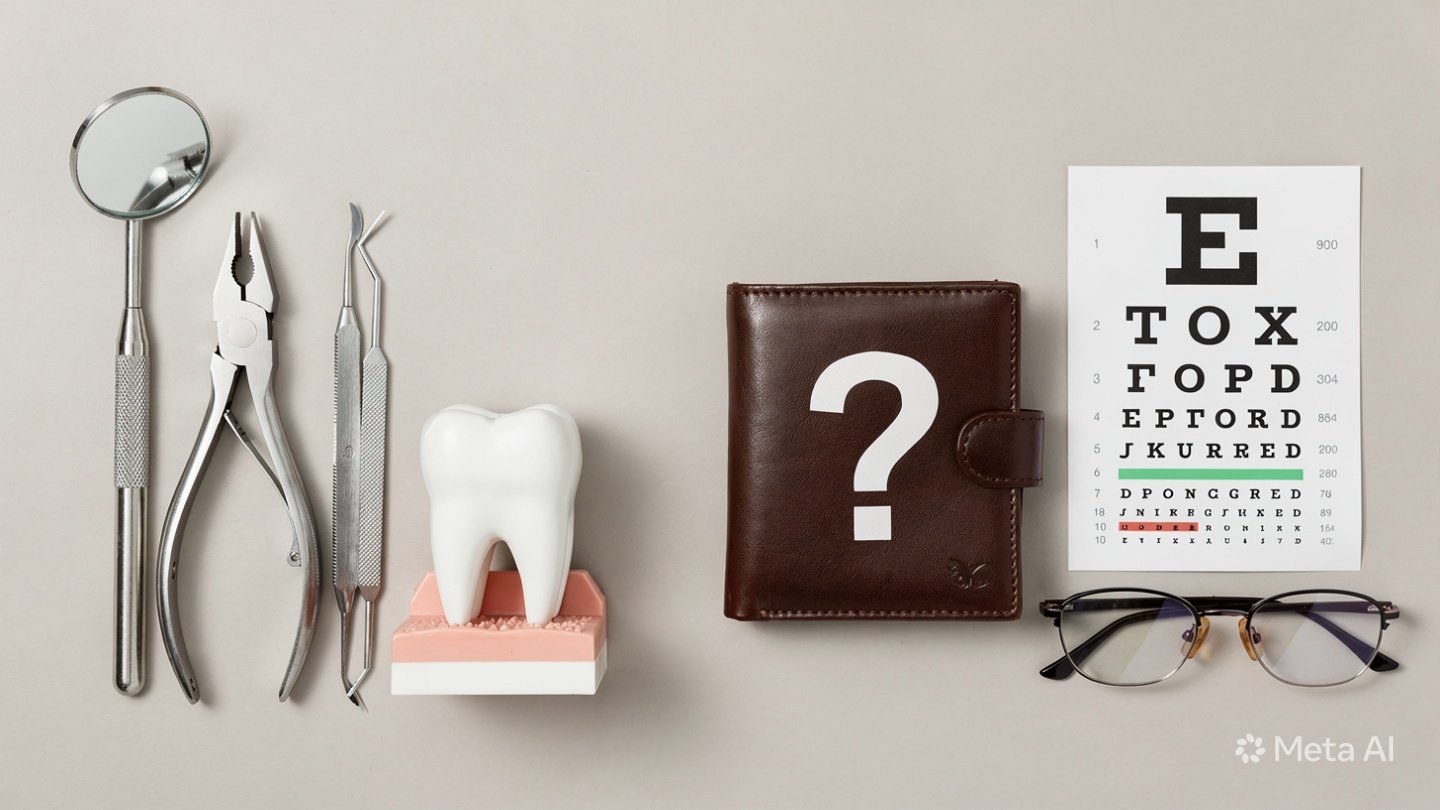
Dental and Vision Insurance – Essential or Complete Waste of Money?
You brush twice a day. You wear your reading glasses when needed. You feel fine. So why does every open enrollment period leave you staring at your screen, paralyzed by the decision to check the “Dental” and “Vision” boxes? You are not alone. Millions of Americans pay roughly $50 billion annually on dental premiums alone, yet nearly 40% of those policyholders never hit their annual maximum benefit.
The insurance industry markets these plans as “affordable add-ons,” but are they actually protecting your health or just siphoning cash from your wallet? The answer, frustratingly, is both.
For some people, dental and vision insurance is the smartest $20 they spend each month. For others, it is a psychological trap that preys on the fear of a root canal. Let’s cut through the marketing jargon. Here is exactly how to decide if these plans are essential protection or a complete waste of money.
The Naked Truth About Dental Insurance
Dental insurance does not work like medical insurance. Medical insurance protects you from a $200,000 heart attack. Dental insurance is designed for predictable, low-cost maintenance. Understanding this distinction is the first step to knowing if you need it.
Most dental plans operate on the 100-80-50 rule.
- 100% covered: Preventive care (cleanings, exams, X-rays).
- 80% covered: Basic procedures (fillings, extractions).
- 50% covered: Major procedures (crowns, bridges, root canals).
But here is the catch: virtually every plan has a low annual maximum, usually between $1,000 and $2,000. In an era where a single dental implant can cost $5,000, your insurance hits a hard ceiling very quickly.
When Dental Insurance is Essential
You should absolutely buy dental insurance if you fall into any of these three categories.
You have a history of cavities or gum disease. If your dentist has mentioned “periodontal pockets” or you have had three or more fillings in the last two years, you are a high utilizer. Two cleanings ($300), a set of X-rays ($150), and one filling ($200) already exceed most annual premiums ($350–$500). You win.
You have dependents under 18. Children need orthodontic evaluations, sealants, and the inevitable sports-related chipped tooth. Pediatric dental care is expensive. Insurance turns a $600 emergency visit into a $50 copay. Furthermore, the pediatric dental mandate under the Affordable Care Act (ACA) makes these plans highly subsidized for kids.
You hate budgeting for surprises. If you prefer paying $45 a month to avoid a sudden $900 bill for a cracked molar, the “peace of mind” premium is worth it. Insurance turns unpredictable expenses into predictable monthly overhead.
When Dental Insurance is a Complete Waste
You are flushing money away on dental insurance if the following is true.
Your teeth are titanium. If you are 35, have never had a cavity, floss religiously, and see the dentist once a year, you are subsidizing everyone else. Your annual premium ($500) plus your deductible ($50) plus your copays ($50) likely exceeds the cash price of two cleanings ($300).
You have a Health Savings Account (HSA). If you have a high-deductible medical plan with an HSA, you can use those pre-tax dollars to pay for any dental work. A discount dental plan (a membership club, not insurance) paired with HSA contributions often yields better value than traditional insurance.
Your employer offers a “break-even” calculator. Many HR portals have a tool that compares your projected usage against premiums. If you used zero major services last year and have no impending work, skip the coverage for 12 months and pay cash.
The Vision Insurance Mirage
Vision insurance is a different beast entirely. Unlike dental, which treats disease, vision insurance primarily buys hardware: glasses and contact lenses. Most plans cost $10 to $20 per month. In return, you get:
- An annual eye exam (retail value: $100–$150).
- An allowance for frames (typically $150 toward a $300 pair).
- A discount on lenses (anti-glare, transitions, etc.).
On paper, this looks great. In practice, the math rarely works in your favor.
The “Allowance Illusion”
Vision insurers negotiate exclusive contracts with frame manufacturers (think Luxottica, which owns nearly every eyewear brand). The “$150 frame allowance” applies only to marked-up frames. The same $150 frames at the insurance-approved optical shop cost $79 on Zenni Optical or Warby Parker online.
You are essentially paying $240 in annual premiums to receive $150 in frame credit and a $100 exam. That is a net gain of $10—except you are locked into expensive lens upgrades because the basic plastic lenses are free but functionally useless.
When Vision Insurance is Essential (Yes, Really)
Despite the cynicism, vision insurance makes sense for specific groups.
You require high-index or progressive lenses. If your prescription is stronger than -4.00, standard lenses turn into Coke bottles. “High-index” lenses reduce weight and thickness, costing $150–$300 extra out of pocket. Vision insurance typically covers these upgrades at 20–30% off. For complex prescriptions, those discounts exceed the annual premium.
You have a family of four. Family plans are the secret sweet spot. One exam for you ($100), one for your spouse ($100), two for kids ($200), plus two pairs of children’s glasses ($300 retail). Total cash price: $700. Annual family vision premium: $360. You save $340. The math flips dramatically with volume.
You have diabetes or glaucoma risk. Medical insurance covers medical eye exams (retinal imaging for diabetic retinopathy). But routine refractions (the “which is better, one or two?” test) are not covered. Vision insurance bundles the medical and routine components into one low copay. If you have a chronic condition requiring quarterly monitoring, this is a steal.
When Vision Insurance is a Scam
You are wasting money if you only wear contact lenses and buy them online. The typical vision plan gives you a $150 contact lens allowance. But 1-800-CONTACTS or Costco sells your annual supply for $180. Your premiums cost $240. You just paid $60 extra to use a “benefit.”
Similarly, if you had LASIK or PRK surgery and no longer need correction, vision insurance offers zero utility. Cancel it immediately.
The “Cash is King” Strategy
Before you click “enroll,” run a simple calculation. Call your dentist and optometrist. Ask for their cash pay price for:
- Comprehensive exam + cleaning + bitewing X-rays.
- Eye exam + standard frame + single-vision lenses.
Many dental offices offer in-house “membership plans” for $200–$300 per year that include two cleanings and 20% off fillings. These are often cheaper than insurance premiums when you factor in deductibles and waiting periods.
The Waiting Period Trap
Here is a dirty secret the insurance companies do not advertise. Most individual dental plans impose a six to twelve month waiting period for major services like crowns, root canals, or periodontics. You cannot buy a policy today and get a crown tomorrow.
If you need immediate work, insurance is worthless. You are better off negotiating a cash discount with your provider or using CareCredit (a medical credit card) with 0% interest for 12 months.
The High-Income Exception
For high earners (over $200,000 household income), the calculus changes again. Dental and vision premiums are often paid pre-tax through a Section 125 cafeteria plan or Flexible Spending Account (FSA). Even if you do not “use” the insurance, the tax savings on the premium (32% marginal rate + state tax) effectively discounts the policy by one-third. At that level, the waste is minimal; the convenience is high.
A Hybrid Approach That Saves Thousands
Stop treating these as “all or nothing” decisions. The smartest consumers use a hybrid model.
- Buy dental insurance if you have a family or bad teeth. Self-insure (save $50/month in a separate savings account) if you have perfect teeth.
- Skip vision insurance for adults who buy glasses online. Buy vision insurance for children or for adults with complex progressive lens needs.
- Never buy both from the same carrier if you pay retail. Standalone dental and standalone vision plans almost always beat “combo” packages, which bake in administrative fees.
The Verdict: Essential or Waste?
Dental insurance is essential for the 74% of adults who have some form of gum disease or a history of fillings. For the minority with genetically perfect teeth, it is a waste.
Vision insurance is essential only for families with children or adults with complex prescriptions (prism, high-index, or progressives). For the average adult who buys $99 glasses online twice a decade, it is a complete waste of money.
The bottom line? Stop auto-renewing these policies every year. Re-evaluate your dental and vision needs every twelve months. If you did not use your benefits last year and have no upcoming procedures, drop the coverage. Put the saved premium into an emergency dental fund. You will likely come out ahead—and if a true catastrophe happens, that fund will pay for your crown without the insurance company’s red tape.
Your eyes and teeth are irreplaceable. The insurance that protects them? Very replaceable. Choose wisely.